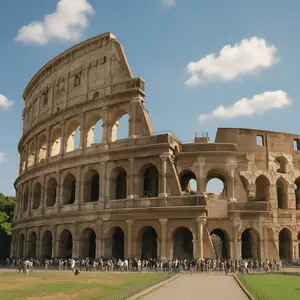
Your cruise ship docks at 7 a.m. and departs at 7 p.m. You have one precious day to experience Rome, a city built over millennia. The thought alone can be stressful, but you can have an incredible day without a frantic dash if you have the right plan.
Your entire day hinges on one decision: choosing how to get to Rome from Civitavecchia port. This single choice dictates your budget, schedule, and freedom. Understanding the real-world trade-offs between the three primary options is the key to a successful day.
Each choice has clear benefits and drawbacks based on what you value most: cost, convenience, or simplicity.
- Train: The best value by far. For around €12 and a 70-80 minute journey, you gain independence to explore on your own schedule. The trade-off is that it requires the most self-management.
- Private Car: The most convenient and fastest option. A driver takes you directly from the port to the city center in about 60 minutes, but this door-to-door service is the most expensive, typically starting at €500+ per vehicle.
- Ship Excursion: The easiest, worry-free choice. For roughly $150+ per person, all logistics are handled for you. However, you sacrifice flexibility and will be part of a large group on a fixed itinerary.
For most travelers who value a blend of independence and affordability, the train offers an unbeatable balance. The next sections provide a step-by-step walkthrough for each option, ensuring you can confidently pick the right one for your perfect day in Rome.
How to Master the Civitavecchia to Rome Train Journey in 5 Simple Steps
Of all the ways to get to Rome, the train offers the best blend of cost, speed, and independence. While it might seem intimidating, the process is straightforward and used by thousands of cruise passengers daily. Think of it as your first authentic Italian experience.
This five-step plan has you covered from the port entrance to your seat. The key is buying the right ticket and completing one crucial action before you board.
- Catch the Free Shuttle: From your ship, follow signs for the free port shuttle bus. It will take you on a short 5-minute ride to the port’s main entrance, called Largo della Pace.
- Walk to the Station: From the shuttle drop-off, it’s a simple 5-to-10-minute walk straight down the main road to the Civitavecchia train station. You can’t miss it.
- Buy a “BIRG” Ticket: Ignore the main ticket counters. Instead, go to the newsstand inside the station (look for the big ‘T’ sign for a Tabacchi). Ask for a “BIRG” ticket. For around €12, this pass covers your round-trip train journey plus all-day access to Rome’s metro, buses, and trams.
- CRUCIAL: Validate Your Ticket! Before heading to the platform, you must stamp your ticket. Look for the small, green and white validation machines. Forgetting this step is like flying without a boarding pass; your ticket isn’t valid, and you risk a hefty fine.
- Board a Train to Roma Termini: Find a train heading to Roma Termini, which is Rome’s main central station. The ride takes about 70-80 minutes.
While the BIRG ticket is the best value, you can check the Civitavecchia to Rome train timetable for the slightly faster (and more expensive) Civitavecchia Express train if every minute counts. Once you arrive at Roma Termini, you’re officially in the heart of the city, ready to explore.

What to See in Rome in 6 Hours: The Realistic ‘Pick 3’ Strategy
With Rome spread out before you, the urge to see it all is powerful. But trying to race between a dozen sights is the fastest way to see nothing but crowds and the inside of a taxi. For a successful day trip, especially when doing Rome on your own from a cruise ship, embrace the ‘Pick 3’ strategy. Focusing on just three major highlights allows you to actually experience them and enjoy a relaxed lunch, rather than just checking names off a frantic list.
To make your choice easier, think of Rome’s attractions in geographical clusters. The ancient heart of the city, for example, puts the Colosseum, Roman Forum, and Palatine Hill all within a few minutes’ walk of each other. Likewise, the Vatican City cluster contains St. Peter’s Basilica, St. Peter’s Square, and the Vatican Museums. Grouping your picks this way transforms your day from a city-wide dash into a pleasant, efficient walk.
There is one non-negotiable rule: you must book tickets for major sites like the Colosseum or Vatican Museums weeks in advance. A pre-booked, timed-entry ticket is like a VIP pass; you’ll walk straight past the two-hour-plus ticket queues. Showing up without one almost guarantees you will spend half of your precious few hours just waiting to get in.
The formula is simple: choose a cluster, pick your top sights within it, and book your entry times online. This disciplined approach is the key to a memorable, stress-free day.
Your 6-Hour Rome Itinerary: The ‘Ancient History’ Express
If your dream is to walk in the footsteps of emperors and gladiators, this is the itinerary for you. It focuses on the ancient heart of Rome and uses the city’s subway system for one quick, strategic jump to save you precious time and energy. Once you arrive at Roma Termini, Rome’s main train station, don’t head for a taxi. Instead, follow the big red “M” signs to the Metro. This is your secret weapon for getting from the station to the Colosseum in under 15 minutes.
This plan assumes you’ve pre-booked your Colosseum entry for 10:00 AM. Simply follow these steps for a perfectly paced day.
- 9:30 AM: Arrive at Roma Termini station.
- 9:45 AM: Take Metro Line B (the blue line) two stops to the ‘Colosseo’ station. You’ll exit with the Colosseum directly in front of you.
- 10:00 AM: Use your pre-booked ticket to explore the Colosseum and adjacent Roman Forum.
- 1:00 PM: Begin the 20-minute walk to the Pantheon.
- 2:00 PM: Take the short 10-minute walk to the Trevi Fountain.
- 2:30 PM: Grab a quick lunch.
- 3:30 PM: Start your return to Termini station to catch the train back to Civitavecchia.
To stick to this tight schedule, skip the formal, sit-down restaurant for lunch. Instead, do as the Romans do and look for a “Pizza al Taglio” shop. These are counters that sell fantastic, thick-crust pizza by the rectangular slice—it’s fast, delicious, and lets you eat on the go. Hitting that 3:30 PM departure gives you a comfortable buffer, ensuring your incredible day in ancient Rome ends with a relaxing train ride, not a frantic dash to the port.

Your 6-Hour Rome Itinerary: The ‘Vatican & Fountains’ Sprint
If your top priority is the magnificent St. Peter’s Basilica, this itinerary is designed for you. It skips Rome’s main hub, Roma Termini, and uses a clever shortcut that puts you right where you need to be, saving at least 30 minutes of precious travel time. This is the best way to see the Vatican from a cruise if it’s your non-negotiable highlight.
The secret is to take a regional train from Civitavecchia that stops at Roma San Pietro station. Not all trains do, so check the departure board for this specific stop before you board. It’s a small station just a 10-minute walk from St. Peter’s Square. This simple move completely bypasses the need for a metro or taxi from the main station, putting you directly into the action.
A crucial warning for your tight schedule: you will not have time for the Vatican Museums. Visiting them is a 3-4 hour commitment on its own. Instead, focus on the breathtaking St. Peter’s Basilica and the famous square. The security line for the Basilica typically moves quickly, allowing you to experience the heart of the Vatican without sacrificing your entire day.
After soaking in the grandeur of St. Peter’s, enjoy a scenic 30-minute walk across the Tiber river to the iconic Pantheon. From there, it’s just another 10 minutes to the Trevi Fountain for that mandatory coin toss. Grab a quick pizza slice nearby, then take a 15-minute taxi ride from the Pantheon area back to Roma Termini to ensure you have plenty of train options for the journey back to port.
Getting Back on Time: Your No-Stress Return Strategy
Enjoying your day is important, but getting back to the port on time is the mission. To eliminate return-trip anxiety, follow the Golden Rule: your train must depart from Rome no later than 3.5 hours before your ship’s final departure time. This accounts for the ~75 minute train ride, the walk to the port shuttle, and provides a comfortable one-hour buffer at the pier. There is no room for negotiation on this—it’s the key to a stress-free finale.
Adopt the “Buffer Train” strategy. When you check the train timetable for your return, don’t just find one train; find two. Plan to catch the earlier one. If you make it, fantastic—you have extra time at the port. If you miss it, your real target train is still waiting. This built-in backup is the single best way to manage risk when exploring Rome on your own.
What about the worst-case scenario? The one word you need to know is sciopero (pronounced sho-PER-o), which means “strike.” If you see this word on station signs or hear it from officials, your train plan is over. Do not wait. Immediately find a licensed white taxi and tell the driver you need to go to the “porto di Civitavecchia.” The ride will be expensive, but it’s a small price to pay for not missing your ship.
This careful exit strategy allows you to relax and truly immerse yourself in the city. By having a non-negotiable departure time, a backup train in mind, and a plan for emergencies, you have a concrete plan to ensure you make it back.
Your Rome-in-a-Day Final Checklist: 7 Steps to a Perfect Trip
With the right preparation, a perfect day in Rome from your cruise ship is not just possible, but incredible. This final checklist is your blueprint for a smooth, stress-free adventure. Before you go, screenshot this mission briefing for your trip.
Your Rome-in-a-Day Mission Checklist:
- Pre-Book Sights Online: Your non-negotiable pass to skip multi-hour lines.
- Choose Your Transport: The train is your most efficient and independent option.
- Pack Smart: Comfortable shoes, a water bottle, and a portable charger are essential.
- Master the Train: Get a BIRG ticket and—most importantly—VALIDATE it before you board.
- Follow Your ‘Pick 3’ Itinerary: Stick to your plan to avoid decision fatigue.
- Obey the 3.5-Hour Return Rule: Be on a train leaving Rome 3.5 hours before your ship’s departure.
- Have a Backup: Know where the nearest official taxi stands are, just in case.
By handling the logistics now, you’ve given yourself the gift of being fully present for the magic of the city—ensuring you return to your ship with incredible memories, not anxiety.

Q&A
Question: What’s the best way to get from Civitavecchia to Rome for a one-day visit? Short answer: It depends on your priorities. The train is the best value (~€12, 70–80 minutes) and gives you full independence, but requires self-management. A private car is fastest and most convenient (about 60 minutes, door-to-door) but pricey (€500+ per vehicle). A ship excursion is the simplest and worry-free (about $150+ per person) but locks you into a fixed group itinerary with limited flexibility. Most travelers seeking a balance of cost and freedom should take the train.
Question: How do I correctly buy and use the BIRG ticket from Civitavecchia? Short answer: After taking the free port shuttle to Largo della Pace, walk 5–10 minutes to Civitavecchia station. Skip the main ticket counters and buy a “BIRG” ticket at the Tabacchi/newsstand (look for the big “T”). For about €12, it covers your round-trip train plus all-day Rome metro, buses, and trams. Before boarding, you must validate it in the small green-and-white machines—forgetting risks a hefty fine. Then board any train to Roma Termini (or consider the slightly faster, pricier Civitavecchia Express if every minute counts).
Question: Can I see both the Colosseum and the Vatican in one day? Short answer: Only if you’re disciplined and accept trade-offs. The guide’s “Pick 3” strategy recommends focusing on one geographic cluster (e.g., Colosseum/Roman Forum/Palatine Hill) to avoid time-wasting transit. If the Vatican is non-negotiable, use the Roma San Pietro shortcut and skip the time-consuming Vatican Museums; focus on St. Peter’s Basilica and Square, then add nearby highlights like the Pantheon and Trevi Fountain. Whatever you choose, book timed-entry tickets for major sites weeks in advance to avoid losing hours in lines.
Question: What’s the fastest way to reach the Vatican from the port, and what should I prioritize there? Short answer: Take a regional train that stops at Roma San Pietro (confirm this stop on the departure board before boarding). From there it’s a 10-minute walk to St. Peter’s Square, saving 30+ minutes versus going via Termini. With a tight schedule, prioritize St. Peter’s Basilica and the Square; the Vatican Museums typically require 3–4 hours and don’t fit a 6-hour plan. Afterward, walk to the Pantheon and Trevi, then take a 15-minute taxi to Roma Termini for plentiful return-train options.
Question: How do I guarantee I’ll get back to my ship on time—and what if there’s a strike? Short answer: Follow the Golden Rule: be on a train leaving Rome no later than 3.5 hours before your ship’s final departure. Use the “Buffer Train” strategy by identifying two return trains and aiming for the earlier one. If you encounter a sciopero (strike), don’t wait—immediately take a licensed white taxi and ask for “porto di Civitavecchia.” It’s expensive, but far better than risking a missed departure.